

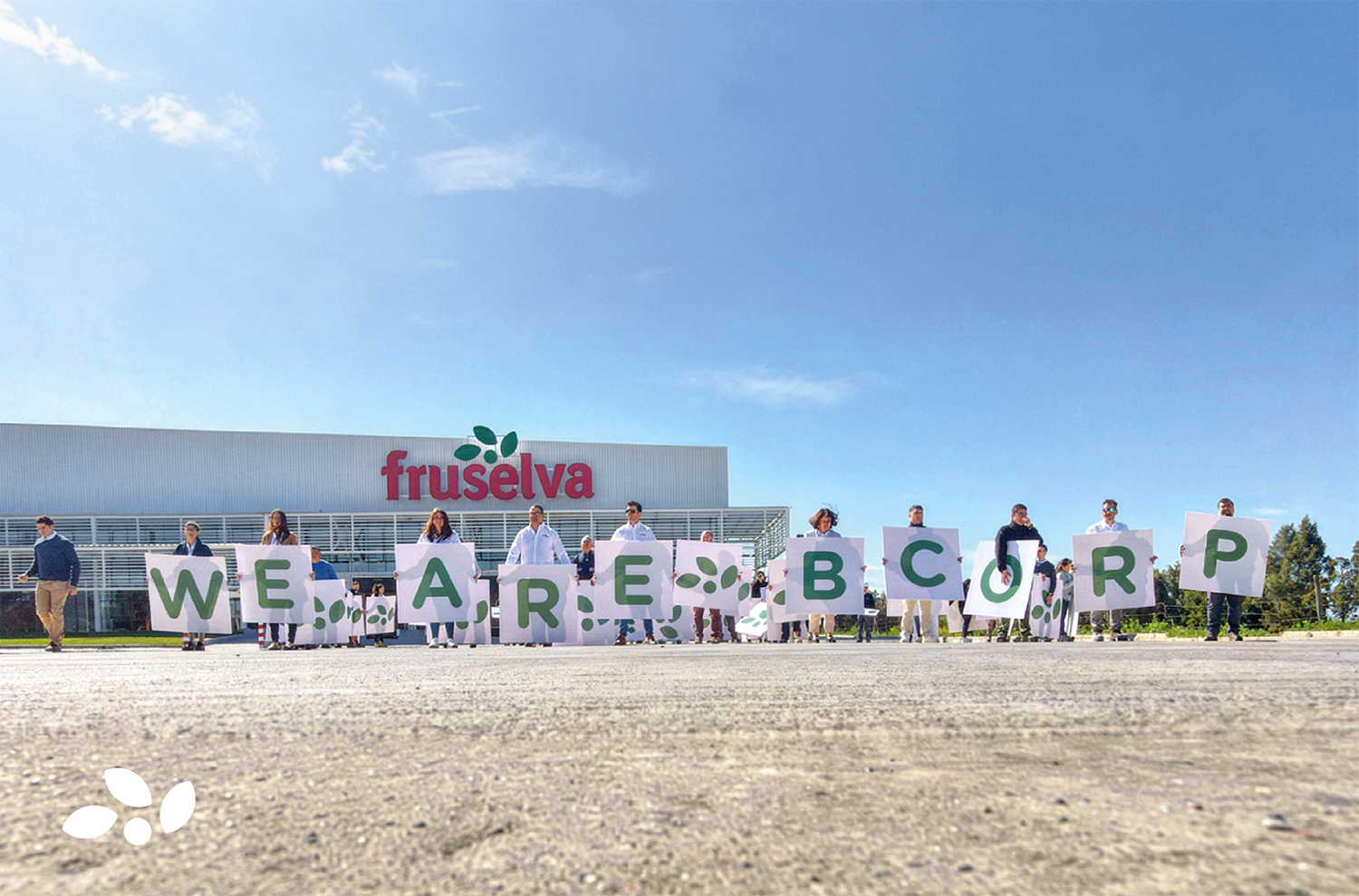
Fruselva shares the interview conducted by Corresponsables with Anna Maria Gallart Serral, Sustainability and B Corp Manager at MaserGrup and Fruselva, as part of the Corresponsables Dossier – B Corp: Companies with Purpose.
In the interview, Anna Maria reflects on the role of sustainability as a management criterion, the importance of integrating social and environmental impact into decision-making, and the value of transparency in communicating not only the company’s progress, but also its challenges and areas for improvement. A conversation that highlights Fruselva’s commitment to innovation, sustainability, traceability and continuous improvement.
Since becoming a B Corp company, what specific changes have you introduced to formally integrate the purpose of creating value for all stakeholders?
At Fruselva, a company belonging to MaserGrup, B Corp certification involved a process of reflection on how we were incorporating social and environmental impact into our decision-making. Rather than a change in direction, it helped us structure and strengthen a way of working that was already part of our corporate culture.
Today, this approach is fully integrated into our day-to-day operations and ensures that strategic decisions are not based solely on economic criteria, but also on their impact on people, the environment and the value chain. This is reflected in specific projects, such as the development of more sustainable packaging, including monomaterial pouches and tethered caps, as well as our commitment to products with improved nutritional profiles that respond to new consumer demands.
In a context marked by the climate crisis, regulatory complexity and economic uncertainty, how does the B Corp approach help you build a more resilient organization in the face of systemic risks?
The B Corp approach has helped us reinforce a fundamental idea: resilience is not only about reacting when a problem arises, but about being able to anticipate it.
As a food company, we operate in a highly changing environment, where regulations evolve rapidly and geopolitical factors can directly affect both our activity and supply chains. This requires us to work with a broader, long-term vision.
In this context, sustainability becomes a management tool that enables us to incorporate environmental, social and value chain variables into our decisions. As a result, we can better anticipate certain risks and reduce the impact of potential disruptions.
B Lab’s new standards include mandatory requirements in areas such as climate action, human rights, fair work and circularity. Which areas do you believe will represent the greatest challenge for organizations?
The new B Corp standards represent an important challenge, both because of their higher level of demand and because of the shift in approach compared to the previous system. Previously, there was a scoring system that made it easier to compare companies; now, the model is more comprehensive and requires a deeper integration of impact into business management.
The main challenge will be cultural. It involves evolving towards a way of working in which impact is fully integrated into decision-making and becomes a shared responsibility across the entire organization.
As in any transformation process, there is a natural resistance to change. For this reason, the challenge will not only be to adapt to more demanding requirements, but also to consolidate a more cross-functional, coherent and integrated way of working.
Being a B Corp means embracing high standards of transparency at a time of increasing scrutiny. How do you manage the balance between communicating progress and acknowledging limitations or areas for improvement?
We understand transparency as the ability to explain the reality of the company in a complete way, not only the progress achieved. Recognizing areas for improvement is also a fundamental part of the process.
What matters is maintaining consistency between what we communicate and what we do, as well as continuing to listen to our stakeholders in order to identify opportunities for improvement and move forward continuously.
What cultural and operational changes has the process of becoming a B Corp company brought about, and how are you transferring these learnings to your value chain?
The B Corp process has mainly represented a cultural evolution. It has reinforced a more cross-functional and collaborative way of working between departments, incorporating impact as another element in decision-making across all areas of the company.
At an operational level, it has also helped improve the measurement and monitoring of indicators, enabling more consistent decisions in the short, medium and long term.
We are progressively transferring these learnings to our value chain through criteria related to sustainability, traceability and continuous improvement. Overall, the process has helped us further align our activity with a shared vision based on innovation, sustainability and commitment to the local area.